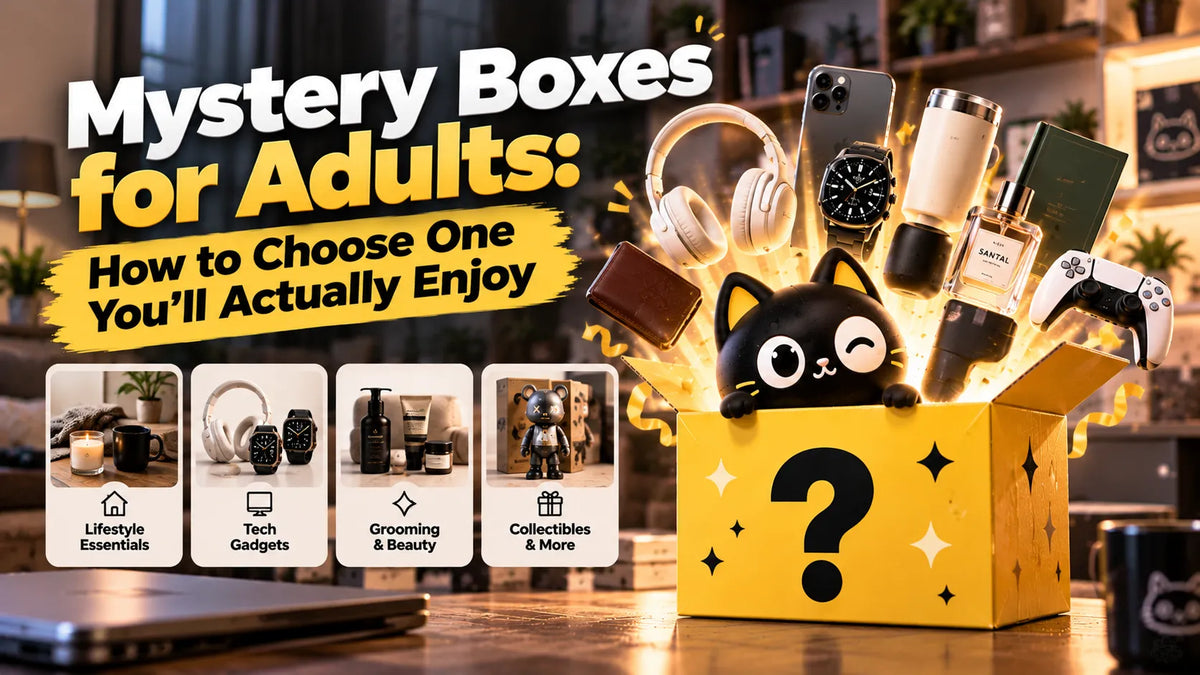

Shopping for a mystery box should feel uncertain in one way: you don’t know exactly what you’re going to open.
It shouldn’t feel uncertain about everything else.
If you’re comparing mystery boxes for sale online, start with five things:
- What types of products can be inside?
- What condition are those products in?
- How does the seller calculate the box’s value?
- Which products are guaranteed—and which are only possible?
- What happens after you pay: shipping, tracking, returns, and support?
A $100 mystery box isn’t automatically better than a $40 one. And a box advertised with “$300 value” isn’t automatically worth $300 to you.
The better buy is usually the one that gives you enough information to understand the deal without ruining the surprise.
Here’s how to tell the difference.
Mystery Boxes for Sale: What Are You Actually Buying?
A mystery box is different from a normal ecommerce purchase.
With a regular purchase:
Choose a product → See the price → Pay → Receive that product
With a mystery box:
Choose a box or tier → See the price → Pay → Discover the exact contents later
The uncertainty is intentional.
But there’s an important difference between unknown contents and unknown terms.
You may not know which gadget, collectible, beauty product, accessory, or other item you’ll receive.
You should still be able to understand:
- The general product category
- The condition of the merchandise
- How value is described
- What the seller actually guarantees
- Shipping expectations
- Return or refund rules
If you’re completely new to the format, our guide to how mystery boxes work explains the mechanics in more detail.
The 5-Point Mystery Box Check
Before buying any mystery box online, run the listing through these five checks.
Think of it as a quick filter between fun uncertainty and unnecessary uncertainty.
1. Product Pool Transparency
Start with the most basic question:
What kind of products could actually be inside?
A seller doesn’t need to reveal the exact contents. That would defeat the purpose.
But there should be some boundaries.
An electronics mystery box, for example, might contain gadgets, accessories, peripherals, smart devices, or other tech-related products.
A beauty mystery box might include skincare, makeup, beauty tools, or personal care products.
A mixed mystery box can be much broader.
What matters is whether you understand the product pool you’re buying into.
More useful
May contain electronics, accessories, gadgets, and tech-related products.
Less useful
Amazing surprises worth up to $$$ inside!
The first tells you something about the purchase.
The second mostly tells you how the seller wants you to feel about it.
2. Value Basis
Suppose you see:
$50 Mystery Box — Up to $150 in Value
That sounds straightforward.
It isn’t necessarily.
Ask what “$150 in value” actually means.
Products can be valued in several ways:
MSRP
The manufacturer’s suggested retail price.
Current retail price
What the product is currently being sold for.
Sale or clearance price
What shoppers can realistically buy it for during a promotion or clearance.
Estimated resale value
What the product might sell for on a secondary market.
Those numbers can be very different.
Imagine a product with:
Original MSRP: $79
Current typical retail price: $49
Clearance price: $29
If a mystery box counts the product as “$79 in value,” that doesn’t necessarily mean the number is false if MSRP is clearly the stated basis.
But it does mean that MSRP and today’s market price shouldn’t be treated as the same thing.
That’s why value methodology matters more than a giant headline number.
We break this down further in our guide to mystery box value.
3. Product Condition
Never assume every mystery box uses the same type of inventory.
Depending on the seller and business model, merchandise may be:
- New
- Overstock
- Clearance
- Discontinued
- Open-box
- Customer returns
- Mixed-condition inventory
Overstock isn’t inherently bad.
Neither is clearance inventory.
Excess inventory is one reason some sellers can offer products below their original retail prices.
The issue is disclosure.
If you’re expecting new merchandise, you shouldn’t discover after delivery that the box primarily uses returned or open-box inventory.
Before ordering, look for a clear explanation of product condition.
If you can’t find one, that’s a reasonable question to ask the seller.
4. Guaranteed vs. Possible Contents
This might be the most important distinction on a mystery box page.
Suppose the promotional image shows:
- Wireless earbuds
- A smartwatch
- A gaming accessory
- A premium electronic device
What does that image actually mean?
There are at least three possibilities.
Guaranteed
Every qualifying box contains that product or an explicitly stated equivalent.
Possible
The product is part of the potential product pool, but only some boxes contain it.
Illustrative
The image represents the general category rather than a specific possible item.
Those aren’t interchangeable.
Promotional imagery shouldn’t be treated as a guarantee unless the seller actually says it is one.
This matters particularly when one expensive product dominates the presentation of a much cheaper mystery box.
5. Fulfillment Transparency
The mystery should end with the contents.
Not with the delivery.
Before paying, check:
- Where the seller ships
- Estimated processing time
- Estimated delivery time
- Shipping cost
- Whether tracking is provided
- What happens if a package is lost or damaged
- Whether mystery boxes can be returned
- How to contact customer support
The U.S. Federal Trade Commission recommends checking sellers, delivery promises, refund policies, and payment protections when shopping online.
FTC Consumer Advice: Online Shopping
The same basic habits apply when buying a mystery box.
Mystery shopping is still shopping.
If you’re considering an unfamiliar seller, our guide to checking whether a mystery box website is legit goes deeper into the trust signals worth checking.
Price vs. Value: What Are You Really Paying For?
One of the easiest mistakes is treating price and value as the same thing.
They’re not.
Consider three different concepts.
Purchase Price
What you pay for the box.
For example:
$50
Stated Product Value
The combined value assigned to the products inside according to the seller’s disclosed valuation method.
For example:
$80
Personal Value
How useful or desirable those products actually are to you.
This is impossible for a seller to guarantee.
Imagine two $50 mystery boxes.
Box A
Contains products with a stated combined value of $90, but you wouldn’t personally use most of them.
Box B
Contains products with a stated combined value of $70, but several are things you genuinely like.
On paper, Box A “wins.”
For you, Box B might be the better purchase.
That’s why mystery box value shouldn’t be reduced to:
I paid $50 and received $X.
Part of the purchase is also the discovery experience.
If you don’t value that uncertainty at all, buying the exact product you want will usually make more sense.
What Should You Expect at Different Mystery Box Prices?
There isn’t a universal standard for what a $25, $50, or $100 mystery box must contain.
Different sellers use different inventory, sourcing models, margins, and product categories.
But price should change the questions you ask.
Lower-Priced Mystery Boxes
These can make sense for:
- First-time buyers
- Casual unboxing
- Small gifts
- Trying a seller before spending more
At this level, focus less on chasing a premium “hit” and more on whether the overall experience makes sense for the price.
Mid-Tier Mystery Boxes
As the price increases, buyers should expect clearer information about:
- Product categories
- Number or range of items, where applicable
- Value methodology
- Product condition
- Differences between box tiers
The more you spend, the more important transparency becomes.
Premium Mystery Boxes
A premium price doesn’t automatically mean a premium outcome.
Before spending more, ask:
What specifically changes between this tier and the cheaper one?
More products?
Higher-value inventory?
A different product pool?
A different minimum value?
Access to products unavailable in lower tiers?
If the only obvious difference is a larger price tag and a more expensive product pictured on the page, you don’t yet have enough information.
Which Type of Mystery Box Should You Buy?
The best category depends on what kind of uncertainty you actually enjoy.
Electronics Mystery Boxes
These are better suited to shoppers who enjoy gadgets, accessories, peripherals, and discovering new tech-related products.
Electronics can vary significantly in price and condition, so pay particular attention to how the seller describes both.
Before choosing one, read our electronics mystery box buying guide.
Beauty Mystery Boxes
Beauty boxes can include skincare, makeup, personal care products, beauty tools, and related items.
Personal preference matters more in this category than it does with many general merchandise boxes.
Someone who enjoys trying a wide range of products may get much more from the experience than someone looking for one particular item.
See our beauty mystery box guide for a deeper look at what to consider.
Clothing and Fashion Mystery Boxes
These can contain apparel, accessories, jewelry, bags, and other fashion items.
Sizing introduces another variable.
Before ordering, check whether the seller asks for sizing information, focuses on universal-size products, or explains how sizing is handled.
Our clothing mystery box guide covers these considerations in more detail.
Toy and Collectible Mystery Boxes
These are aimed more toward shoppers interested in figures, toys, collectibles, and pop-culture merchandise.
But don’t automatically confuse them with blind boxes.
Mystery Box vs. Blind Box
A blind box usually comes from a known collectible series. You know the collection but not which specific character or variation is inside.
A mystery box is generally broader and can contain several unknown products from one or multiple categories.
If you’re deciding between the two formats, see our full mystery box vs. blind box comparison.
Mixed Mystery Boxes
Mixed boxes offer the broadest product pool and therefore the greatest uncertainty.
Tech today.
A collectible tomorrow.
An accessory in another box.
They’re better suited to shoppers who care more about the unboxing experience than receiving products from one particular category.
7 Red Flags to Watch for Before Buying a Mystery Box
Mystery doesn’t mean you should switch off your judgment.
1. The Most Expensive Product Dominates Everything
If a $30 box is marketed almost entirely around a $1,000 product, find out how that product actually relates to the offer.
Is it guaranteed?
Possible?
Rare?
Illustrative?
Those distinctions matter.
2. No Clear Product Category
You shouldn’t necessarily know the exact products.
You should understand the nature of the box.
3. No Explanation of Product Condition
New and returned merchandise aren’t equivalent.
The listing should make the distinction clear.
4. Vague Value Claims
“Massive value” isn’t a methodology.
Look for enough information to understand how value is being represented.
5. No Shipping Expectations
You shouldn’t have to buy first and discover the delivery estimate later.
6. No Visible Return or Refund Rules
Mystery boxes may have special return conditions.
That’s exactly why you should read them before ordering.
7. Pressure to Chase a Rare Outcome
Be cautious when marketing focuses almost entirely on what the luckiest possible buyer could receive.
Evaluate the box based on what you’re actually purchasing—not just the best imaginable result.
If trust is your main concern, read Are Mystery Box Websites Legit? before placing an order.
The 30-Second Mystery Box Buying Checklist
Before clicking Buy, run through this list.
PRODUCT
☐ Do I know the general product category?
☐ Do I understand the condition of the merchandise?
VALUE
☐ Does the seller explain how value is calculated?
☐ Am I confusing MSRP with current selling price?
EXPECTATIONS
☐ Do I understand what is guaranteed?
☐ Do I understand what is merely possible?
DELIVERY
☐ Can I find shipping time and cost?
☐ Is tracking available?
POLICIES
☐ Have I checked the return/refund policy?
☐ Can I find a way to contact the seller?
PERSONAL DECISION
☐ Would I still enjoy opening this box if I don’t receive the product I’m secretly hoping for?
That last question matters more than it looks.
If the answer is no, you may be better off buying that specific product directly.
If you’re ready to shop but want a more detailed walkthrough first, see how to buy a mystery box online.
What We Think a Mystery Box Listing Should Tell You
At BoxieJoy, we think mystery should apply to the individual contents—not to the basic terms of the purchase.
A useful mystery box listing should help shoppers understand:
Category
What general types of products could appear?
Condition
What kind of inventory is being used?
Value
How should stated value be interpreted?
Possibility vs. guarantee
Are the products shown guaranteed, possible, or illustrative?
Fulfillment
What should happen after the order is placed?
These are the same principles we use when thinking about how mystery boxes should be presented at BoxieJoy.
The goal isn’t to remove uncertainty.
Without uncertainty, it wouldn’t be much of a mystery box.
The goal is to put the uncertainty in the right place.
Are Mystery Boxes Worth Buying?
For the right buyer, they can be.
But not because every mystery box guarantees you’ll receive more than you paid.
And not because every box contains a hidden jackpot.
Mystery boxes make the most sense when three things are true:
You enjoy discovery.
You understand what you’re buying.
You’re comfortable with the price even though you don’t control the exact contents.
If you need one particular product, buy that product.
If you’d be disappointed by anything except the most expensive item shown in the listing, don’t buy the box based on that possibility.
But if you enjoy opening something without knowing exactly what’s inside—and the seller gives you enough information to make an informed decision—the uncertainty itself can be part of the value.
Still deciding where to shop? Our guide to where to buy mystery boxes online explains what to compare before choosing a seller.
Frequently Asked Questions
Are the expensive products shown in mystery box photos guaranteed?
Not necessarily. A product shown in promotional imagery may be guaranteed, one of several possible contents, or representative of the category. Check the actual product description rather than assuming every pictured item can or will appear in every box.
Does a more expensive mystery box mean better odds?
Not automatically. A higher price might correspond to more products, a different product pool, higher-value inventory, or another tier structure. Look for an explanation of what actually changes between price levels.
Should mystery box value be based on MSRP or current retail price?
Both figures can provide useful information, but they mean different things. MSRP represents a manufacturer’s suggested price, while current retail price better reflects what shoppers may actually pay today. The important part is understanding which valuation method is being used.
Can you return a mystery box if you don’t like what’s inside?
That depends on the seller’s return policy. Some businesses may restrict returns simply because a customer doesn’t like randomized contents while maintaining separate rules for damaged, defective, missing, or incorrect items. Read the applicable policy before ordering.
How much should I spend on my first mystery box?
Choose a price you’d be comfortable spending even if the contents aren’t exactly what you hoped for. A lower-priced box can also let you evaluate packaging, fulfillment, product quality, and the overall experience before considering a higher tier.
Final Takeaway
There are plenty of mystery boxes for sale online.
The harder part is deciding which ones deserve your money.
Don’t start with the biggest prize in the picture.
Start with five things:
Product pool. Value basis. Condition. Guaranteed vs. possible contents. Fulfillment.
Then ask yourself:
Would I still be happy with the experience if I don’t get the item I’m hoping for?
If the answer is yes—and the seller gives you enough information to understand the purchase—you’ve removed most of the uncertainty that shouldn’t be there.
The rest?
That’s the fun part.
Article Information
Published by: BoxieJoy Editorial Team
Topic: Mystery Box Buying Guides
Last reviewed: October 2026
Our editorial content is created to help shoppers better understand mystery boxes, product value, purchasing considerations, and the unboxing experience. Product availability, prices, policies, and market conditions can change, so always review the current information provided by a seller before purchasing.
Source
U.S. Federal Trade Commission — Online Shopping